Pessimistic, Nihilistic and Absurdist Modern Greek Literature

xylokopos

Chymist
Some time ago, a fellow TLO member asked me to recommend some works of modern Greek literature. I am hardly an expert, but I did suggest a few works of prose and poetry I thought he might enjoy, based on the character of this site and the writers that we enthusiastically promote and devour.

Considering how grateful I am for all the recommendation threads that introduced me to more obscure writers and artists - especially ones that labour outside the anglosphere - I thought I could make myself useful and gather in a single thread a few suggestions for all of you with a taste for the gloomy, the negative and the absurd.


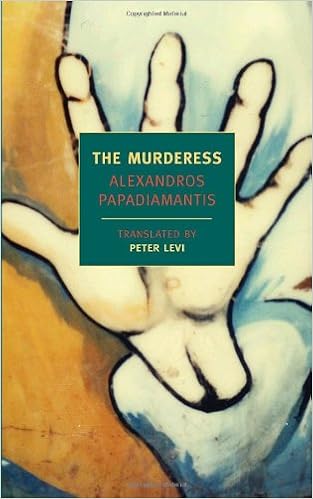
1. Alexandros Papadiamantis, The Murderess
518YBK0Vh%2BL._SX311_BO1,204,203,200_.jpg


Papadiamantis published this novella in 1903, but Peter Levi's English translation came out in the 80s. It is extremely bleak and full of moral ambivalence. It has more antinatalist overtones than any other Greek novel I am familiar with.

Papadiamantis was an ascetic, humble and pious man. Though stratospherically famous in the country of his birth today, he lived a life of poverty and reclusion. He never married and he had no children. A man of God, he drank and smoked himself to an early grave.
 
2. Kostas Karyotakis

KostasKaryotakis3.jpg


Karyotakis has become a byword for pessimism in Greek Letters. He lived a short and miserable life, pursuing his vocation for poetry while suffering the crushing boredom and the indignities associated with being a minor civil functionary in provincial towns. In fact, and in the same vein that some of Ligotti's work falls under the newly-minted category of 'corporate horror', Karyotakis wrote venomous verses against the 'bureaucratic horror' of the Civil Service.

At this point in time, it is pretty well established that his syphilis was the reason his love for the consumptive poetess Maria Polydouri remained unrequited.

In 1928, Karyotakis was posted to the small Northwestern Greek town of Preveza. He lasted about a month before killing himself. The manner of his suicide would have been described by the Ancients as tragelafos, a tragicomedy which leaves one uncertain regarding the appropriate emotional response. Karyotakis first tried to drown himself at sea. He applied himself for ten hours, but being a very competent swimmer, he failed. Next morning he bought a pistol and went to a seaside cafe. He drank cherry juice and smoked for a few hours. Then, he paid, left a massive tip and went and sat under a eucalyptus tree, where he shot himself through the heart.

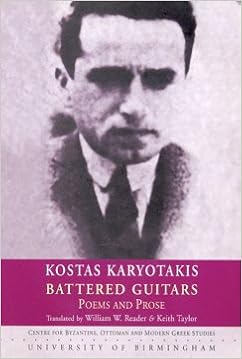
Some of his poetry has been translated into German and Portuguese. In 2006, the University of Birmingham issued the following comprehensive English translation of both his poetry and prose:

41iB2SugjmL._SX240_BO1,204,203,200_.jpg


Battered Guitars: Poems and Prose: Kostas Karyotakis, William W. Reader, Keith Taylor: 9780704425194: Amazon.com: Books

Sadly, it is listed as currently unavailable on Amazon.

The following is an interesting rumination by Keith Taylor, one of the two translators, on how he came to translate Karyotakis in English and what it took to acquire that ability.

https://www.lsa.umich.edu/UMICH/modgreek/Home/Window%20to%20Greek%20Culture/Literature/LIT_Taylor_Keith_Karyotakis.pdf
 
I just waned to say a personal thanks for the recommendations.

I got the Papadiamantis novel from a library today and am devouring it. A fantastic read and I look forward to getting hold of his other writings.

Thanks also for the Dimitris Liantinis tip a while back, although it's difficult to get any of his work in English.
 
Malone, you are most welcome.

Gemma has been translated into English and is available at amazon.

From the back cover:

We start off our lives insubstantial, untested, non-existent, anonymous. Our starting points lie within the ontological oblivion, and inside the opaque fog of concern. And this concern wages out a persistent battle against our being so that we do not have the chance to build strong bonds of kinship with the deeper essence of our existence. Each one of us begins with the name N o b o d y.
 
3. Demosthenis Voutyras, Pararlama

001-cebccf80cebbcebfceba.jpg


Voutyras wrote about 400 short stories in his life, many of them combining the grim and the absurd, the metaphysical and the fantastical. The only story of his I know for a fact has been translated in English is "The Three Tests". It was included in The Dedalus Book of Greek Fantasy.

I attach my translation of Pararlama, one of his better known tales. It is only 1000 words in length and I am certain you will enjoy it.
 

Attachments

Back
Top